FEEL THE POWER

Newsroom

Nick Webster

May 30, 2025

Abu Dhabi Police unveil UAE-made supercharged patrol car

Eneron Magnus designed to take policing to new operational levels in the capital

Abu Dhabi Police have started road testing the first UAE-made Eneron Magnus supercharged patrol vehicle. The Magnus is blast-proofed and can accelerate to 100kph in 6.3 seconds, with a top speed of about 150kph.

On Wednesday, a fully operational technology demonstration vehicle cruised along the Corniche, tailed by a police escort and motorcycle outriders – the first public outing for the latest addition to the force’s rapid response fleet.

Packed with the latest technology, the Magnus belongs to a new class of robust emergency vehicles. The car has been built by developers at Eneron, a subsidiary of Abu Dhabi based technology firm Kintsugi Holding. It made its debut at the Gitex technology exhibition in Dubai last year.

“We’re very proud to have reached this stage in collaboration with our partners Abu Dhabi Police,” said Rashed Al Mohtadi, director of marketing and communications of Kintsugi Holding. “The vehicle can be deployed as a mobile command centre, that has been specified by the police.

“To integrate this kind of technology and equipment within a vehicle of this size, and for it to move at this kind of speed is very difficult to achieve.”

The vehicle has been designed to withstand the most challenging of environments, and is powered by a combined electric motor and diesel engine offering a range of about 900km. Its reinforced suspension system and central tyre inflation system ensures the vehicle can operate under all road conditions, and in more tricky desert terrain. In the event of coming under fire, the Magnus is offered with the option of level B6 ballistic protection, safeguarding the cabin, windscreen and windows against high velocity ammunition, machinegun fire and hand grenades.

Meanwhile, a self-contained, fully ventilated environment protects those inside from contaminated air or chemical attacks. It has an escape hatch, 21 cameras offering 360º vision, and is well equipped for stealth missions, with exterior infrared lighting providing illumination only visible through night vision. There is also a secure cell inside the vehicle, which can monitor the biometrics and vital signs of those inside. Two drones can be launched from the back of the vehicle, mainly for surveillance, or to find the location of suspects from the air.

Voice control

The car has an in-house developed AI-Voice Assistant called SAM. Similar to conversational voice assistants found in many modern electric vehicles, it gives those inside voice control over the deployment of drones and other services that could be operation critical.

As development vehicles continue to be tested, and the Magnus’s off-road capabilities evaluated in the Liwa desert, Mr Al Mohtadi expects a civilian vehicle to be unveiled in 2026, and production in Abu Dhabi to get under way in 2028. Although a price has not been confirmed, developers said it was expected to below the Dh1 million ($272,300) mark.

“We expect this to be used in several scenarios, mainly because of the specifications that the police have requested,” said Mr Al Mohtadi. “As it’s a hybrid range-extender EV, it’s able to operate both in diesel and electric, and comes with different driving modes and various mission-specific functionalities.

“We have received a lot of inquiries from civilians in exhibitions, asking if we are making a civilian version of this vehicle.

“This vehicle is unique. At some point, we would like to take this to a global scale in terms of production. To have a vehicle of this size move so nimbly and smoothly in the street is unheard of.”

Article Source: Al Etihad

KHALED AL KHAWALDEH

February 17, 2025

National Guard shows off new AI-powered 'Magnus' at IDEX

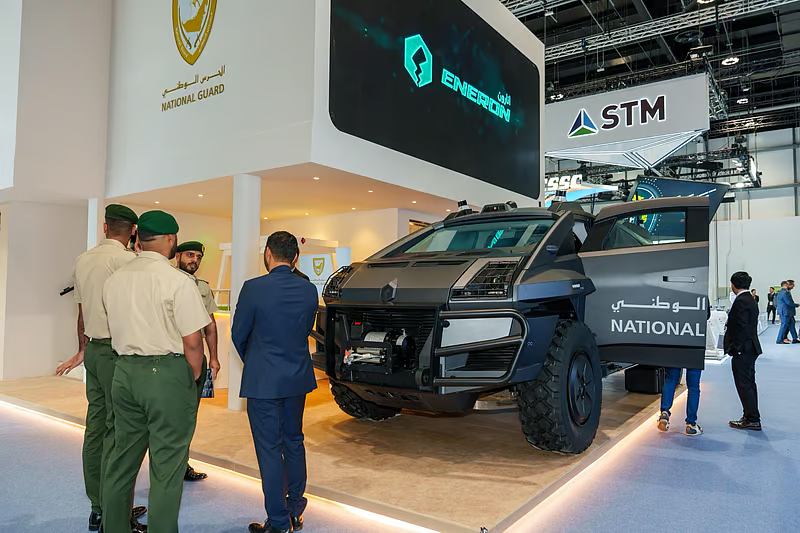
The UAE National Guard exhibited the latest addition to its fleet on the first day of the IDEX exhibition in Abu Dhabi on Monday. Complete with AI navigation, the “Magnus” is intended to act as a moving base, capable of supporting drone operations and recharging equipment in difficult off-road terrain.

“We’re not just unveiling a vehicle, we’re showcasing the future of security and mobility,” Waleed Alblooshi, Senior Manager of Corporate Communications at Eneron, told Aletihad.

Developed by Eneron, a subsidiary of the UAE-based tech, transportation and sustainability solutions company Kintsugi, the multi-use tactical vehicle was made in conjunction with the National Guard to bolster the capabilities of the force.

Complete with autonomous capability, the ability to charge drones and blast protection, the vehicle is the latest high-tech solution to be deployed by Emirati security services and serves as an example of their rapidly evolving fleet.

“Security forces need more than just any vehicle. They need an advantage. Magnus can see everything, go everywhere… in the hardest conditions,” Alblooshi said.

“Magnus can see everything, go everywhere. It can operate in the hardest conditions.”

The Magnus includes an 800-volt hybrid electric engine. The vehicle has a top speed of 130km/h and does zero to 100 in 7 seconds. It generates 800 kilowatts of power, 1072 horsepower and can drive autonomously off-road. It also includes 360-degree real-time surveillance and is equipped with ballistic and anti-mine blast protection.

Perhaps its most critical feature is its mobile charge station, which allows it to charge drones, equipment and other vehicles in the field.

Alblooshi said that the new vehicle, which would set the standard for National Guard equipment, turned heads at the exhibition.

“Lots of crowds on the first day, lots of attention for the Magnus,” he added.

A prototype of the Magnus was launched last year, with Eneron confirming plans for the vehicle to be made in and for the UAE. There are also plans for a street-legal version to eventually be available. The vehicle on display at IDEX was made specifically for the National Guard and the specific needs of the force.

Article Source: Al Etihad

Haneen Dajani

February 17, 2025

IDEX 2025: UAE unveils eye-catching hybrid armoured vehicle with up to 900km range

Magnus can function autonomously in sand, mud, rivers, and mountainous terrain and has built-in drones that can cover a distance of 5km

A locally produced hybrid autonomous armoured vehicle with up to 900km traveling range and supreme charging capacity, is one of the latest transport technologies set to be adopted by the UAE National Guard.

Featured at the International Defence Exhibition (IDEX) taking place in Abu Dhabi this week, the Magnus seamlessly integrates autonomous navigation, electrification, and defence-grade protection.

Compared to other vehicles used by the National Guard, this vehicle has a higher capacity and longer traveling range. It can travel up to 900km in hybrid mode and 140km in electric mode, with a top speed of 130kmph, said First Lieutenant Abdulla Al Ahmad, from the National Guard Capacity Development. “It has more advanced radars, especially for night missions, featuring thermal detection and 360-degree surveillance,” he added.

“Previously, most military vehicles were strictly diesel or petrol. This is the first one with such advanced electric features,” said Waleed Al Blooshi, head of communications at Kintsugi, the manufacturer of Magnus. The significance of the hybrid feature is not just its environmental benefits, but also its practicality and enhanced security. “As a military vehicle, it can operate quietly without drawing attention and is less likely to overheat in high temperatures.” Furthermore, built-in drones can cover a distance of 5km and fly to an altitude of 2km for surveillance purposes.

“Even when the engine is off, the personnel inside the four-seated vehicle can still benefit from the surveillance system through fitted iPads, allowing them to monitor any surrounding movement within a 300m range.” This feature is particularly useful for backseat personnel, as the vehicle has no windows in the rear section. While the Magnus is currently only available as a prototype, full-scale production is set to begin in 2027.

Magnus can function autonomously in sand, mud, rivers, and mountainous terrain. It is also capable of charging associated accessories without external support, “which comes in handy when in the desert, for instance.” The vehicle features a 900-volt capacity powered by an 80kW battery. “If any accompanying device loses power, there’s no need to search for an external power source – the Magnus is equipped with 110 litres of diesel, which helps boost the battery,” explained Al Blooshi.

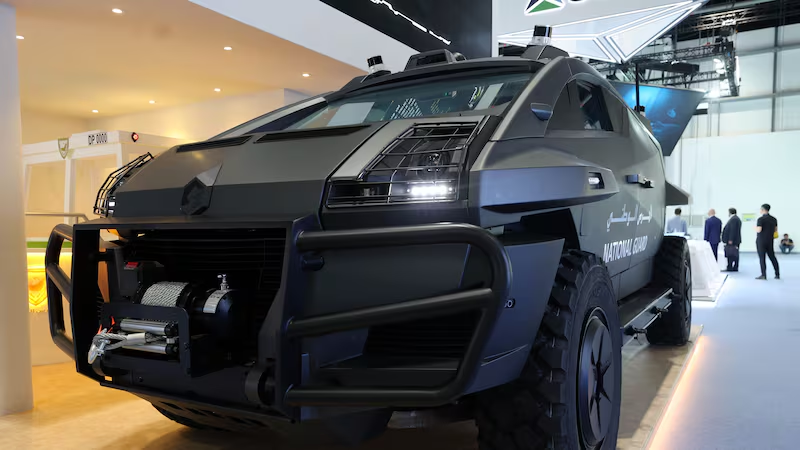
With its futuristic design and black matte paint, the Magnus stands out from other armoured vehicles. “We wanted to create a new kind of military vehicle with a unique design – something that is not just eye-catching, but also high-performing with cutting-edge technology,” he concluded.

Article Source: Khaleej Times

Nick Webster

February 17, 2025

UAE company unveils Eneron Magnus, a rugged hybrid military vehicle

National Guard and Abu Dhabi Police lining up futuristic additions to emergency fleet

A UAE company with big ambitions to rival Tesla on the global stage of production of autonomous vehicles and humanoid robots unveiled its latest off-road hybrid military vehicle in Abu Dhabi.

The Eneron Magnus border patrol vehicle has been built from scratch in the UAE in under three months and is a marker for autonomous electric military vehicles of the very near future.

The concept car is the latest project from government owned Kintsugi Holding, that specialises in autonomous ground transport and the development of humanoid robots that can perform laborious, and dangerous tasks currently completed by humans.

The speciality vehicles have been developed in partnership with the UAE National Guard, and were on show at the Idex defence and security conference in Abu Dhabi on Monday, which was attended by President Sheikh Mohamed, as well as Sheikh Khaled bin Mohamed, Crown Prince of Abu Dhabi, and Sheikh Hamdan bin Mohammed, Crown Prince of Dubai, Deputy Prime Minister and Minister of Defence, who were briefed on a number of the defence systems on display.

What sets the Magnus aside from other autonomous transport is its sleek muscular looks, bulletproof Kevlar shell and 800km range thanks to an electric battery and on board diesel generator.

Composite panels on either side of the vehicle are engineered to pair with ballistic steel and a composite chassis, providing level two ballistic protection from landmines and other incendiary devices.

Its six-seater cabin is similar in size to the Tesla Cybertruck, which is also electric, and can be brought for about $81,000. Kintsugi would not reveal how much the Magnus cost to develop or how much it would retail at, if it becomes commercially available.

More than 20 cameras offer a 360 degree of the outside, while ladar and radar sensors have the vehicle ready for autonomous driving, and an escape hatch in the roof allows for a quick emergency exit.

A futuristic interior features a high-tech digital cockpit design, purpose-built for border patrol operations, while a multifunctional steering wheel and a 10.4-inch central touchscreen with hotkeys is designed for intuitive accessibility.

Sean Teo, managing director of Kintsugi Holding, said common problems with using electric batteries to power heavy armour plated vehicles has been the drain on power, and resulting short range.

“We wanted to completely reinvent the military vehicle,” Mr Teo, told The National. “People said it was crazy to design a vehicle like this because one of the biggest challenges was generating enough torque. When you’re going uphill, after a while the electricity becomes too hot. So we’ve had to refine the entire design to overcome the heat issue by adding a diesel generator.”

Electric power

An electric motor provides 800KW of power, generating a top speed of 130kph and acceleration from a standing start to 100kph in just seven seconds.

Abu Dhabi police has commissioned a smaller version of the Magnus, the Magnum, that can be used for motorway patrols, and emergency response, while Civil Defence is also said to be interested in adding the vehicle to its fleet.

Michael Robinson, a design consultant for Kintsugi, brought his 45 years of experience in the Italian car market to develop the Magnus’s eye-catching looks.

“It’s a giant vehicle, much larger than anything I’ve ever worked on before, so it’s already in a different class,” he said. “I wanted to bring in a new architecture into this industry which tends to be very boxy, with flat, vertical windshields. The entire body is done in Kevlar, so it’s very structurally robust and gives the possibility to do muscular, aggressive shapes.

“It is 100 per cent EV hybrid, with one electric engine in the front axle and one in the rear axle, but the diesel just charges the battery up so we can do 800km which is amazing in such a big beast. We did this in record time, six months to do the engineering on this thing and then three months to build it.”

Robo taxis

Kintsugi said it is in talks to fill the gap in the autonomous taxi market left behind by the issues faced with Cruise, the US self-driving vehicle manufacturer that was trialling routes for its driverless cars in Dubai.

In 2023, regulators in California ordered Cruise – a subsidiary of General Motors – to stop its driverless taxi service in San Francisco after a near fatal incident with a pedestrian who was dragged several metres by the autonomous vehicle.

Mr Teo said the failure of others to develop safe driverless vehicles had created an opportunity for robotaxis built in the UAE by Kintsugi.

“This (Cruise incident) made it all the more important to make sure that we manufacture these vehicles locally, so we can control the availability and quality of services,” he said. “By the end of June you should see about 20 of these vehicles running around the island (Abu Dhabi).”

Article Source: Gulf News

Ali Al Hammadi

February 17, 2025

UAE firm launches new tech for border surveillance

Two next-generation special-purpose vehicles showcased at IDEX

Abu Dhabi: Eneron, a subsidiary of Kintsugi Holding—a government-owned strategic technology company based in Abu Dhabi—has unveiled its latest technology demonstrator, Magnus, alongside its concept vehicle, Magnum, at the International Defence Exhibition & Conference (IDEX) 2025.

The vehicles redefine border security, surveillance, and response capabilities, setting new standards for next-generation special-purpose vehicles.

Addressing evolving threats in border surveillance and security, Eneron integrates advanced technology and future-proof design to develop smarter, faster, and more sustainable mobility solutions. Magnus and Magnum leverage AI-driven surveillance, autonomous navigation, and mission-adaptive features to enhance patrol and response efficiency. With 360° integrated surveillance, dual drone deployments, and AI-assisted patrol capabilities, these vehicles ensure real-time threat detection and interception, significantly strengthening border security.

Designed for operational resilience in hostile environments, they incorporate state-of-the-art cyber and electronic warfare capabilities, including GPS anti-jamming, mesh networking, and secure communications to maintain connectivity in high-threat scenarios.

Built on Eneron’s proprietary hybrid range extender chassis, Magnus and Magnum feature a next-generation hybrid powertrain developed in-house. This enables exceptional range and performance, balancing power and sustainability for both urban and extreme off-road operations.

Complex security

These vehicles are engineered for adaptability in complex security and law enforcement missions, offering multiple operating modes, including:

  • Silent watch mode – for discreet surveillance and operations.
  • 100 per cent electric mode – for reduced emissions and enhanced sustainability.
  • Mobile charging station mode – for supporting other electronic assets in the field.

Sean Teo, Managing Director of Kintsugi Holding, said: “Magnus and Magnum represent a significant leap in border control and law enforcement mobility by integrating AI-driven command capabilities, autonomous navigation, and mission-ready adaptability. With their global debut at IDEX 2025, we are excited to set new benchmarks for tactical mobility, smart policing, and next-generation patrol efficiency.”

Tareq AlBannay, Vice President of Future Systems at Kintsugi, added: “Both Magnum and Magnus embody Eneron’s vision for the future of tactical mobility, where AI-driven intelligence, mission adaptability, and sustainable power converge to redefine law enforcement capabilities. We remain committed to pushing the boundaries of innovation, leveraging cutting-edge technology to enhance safety, efficiency, and sustainability in law enforcement operations worldwide.”

Article Source: Gulf News